SART reporting
Recording Autologous Oocyte Banking Cycles Correctly in SART CORS
How to record autologous oocyte banking cycles correctly in SART CORS, a retrieval with no transfer or outcome, kept separate from the cycle where the eggs are later used.

- SART CORS
- Oocyte banking
- Fertility preservation
- Egg source
Egg banking is now one of the largest categories in US ART reporting. Of the cycles reported to CDC in 2022, more than 184,000 were egg or embryo banking cycles. It is also one of the easiest categories to record inconsistently, because a banking cycle does not behave like a standard IVF cycle. There is no insemination, no transfer, and no pregnancy outcome at the time you report it, and the eggs may not be used for months or years.
Getting the banking cycle right, and keeping it separate from the cycle where the eggs are eventually used, is what keeps your data consistent and your SART CORS validation clean.
Why a banking cycle is not a normal cycle
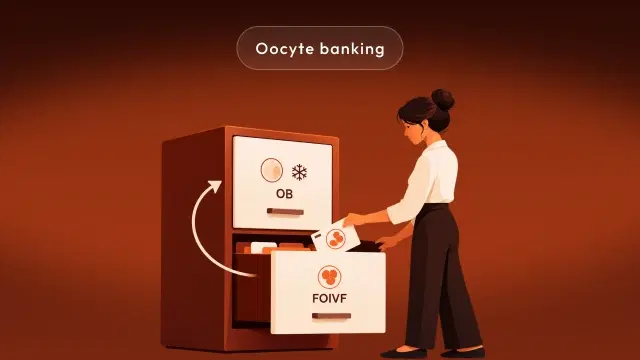
In autologous oocyte banking, the patient stimulates and retrieves their own eggs, which are frozen and stored. That is the entire cycle. Nothing is inseminated, no embryos are created, and nothing is transferred, so the cycle has no pregnancy or birth outcome of its own.
This is why banking cycles sit apart from the usual reporting rhythm. A standard fresh cycle has a retrieval and a transfer close together, and an outcome follows. A banking cycle has a retrieval and then a pause that can last years. The outcome, if there ever is one, belongs to a later cycle. US reporting handles this as a delayed-outcome situation: a retrieval reported in one year whose use, and any resulting pregnancy, may fall in a later reporting year.
Recording the banking cycle
Report the banking cycle for what actually happened:
- A retrieval of the patient's own eggs.
- Egg source as autologous, meaning the patient's own eggs.
- The eggs cryopreserved and stored.
- A reason consistent with why the eggs were banked, whether elective fertility preservation or a medical indication such as banking before gonadotoxic treatment.
What does not belong on a banking cycle is insemination, embryo creation, or transfer, because none of it occurred. The cycle should show a retrieval and a freeze, and stop there.
Recording the later use of the banked eggs
When the patient returns to use the eggs, the thaw, fertilization, embryo creation, and any transfer are recorded as a separate cycle, reported when they happen.
Two things matter in that later cycle. First, the egg source is still autologous, because these are the patient's own banked eggs, which is what distinguishes this cycle from a donor-egg cycle. Second, any pregnancy or birth outcome is reported against the cycle in which the transfer took place, not against the original banking retrieval.
Where banking data goes wrong
The recurring problems with banking cycles are consistent:
- A transfer or an outcome recorded on the banking cycle. A banking cycle has neither. Attaching one misstates what happened and is the kind of internal inconsistency that surfaces in review.
- Egg source coded incorrectly. Banked own eggs are autologous. Coding them as donor, or coding a later donor cycle as own, is a source error, and egg source is one of the fields that distinguishes cycle types in reporting.
- Expecting a banking cycle to show a success rate. It has no outcome by design. The outcome lives with the later transfer cycle, and reading a banking cycle as a failed attempt is a misinterpretation.
- Losing the link between the retrieval and the later use. The banking retrieval and the eventual thaw-and-transfer are two cycles for the same patient. If they read as unrelated events, the journey cannot be followed.
- The wrong reason. Coding a preservation or banking retrieval as a standard IVF attempt changes what the cycle represents.
What CDC validation looks at
SART CORS data feeds the federal reporting system, and CDC validates a sample of each clinic's cycles against the medical record. That sample specifically includes fertility-preservation banking cycles, alongside cycles that did and did not result in pregnancy and cycles using donor eggs or embryos. In other words, banking cycles are not exempt from validation. A banking cycle that carries a transfer or outcome, or that disagrees with the chart on egg source or reason, is exactly the sort of discrepancy a validator is looking for.
How EmbryoLogix catches it before submission
EmbryoLogix validates the shape of each cycle before a file is prepared, not just individual fields. For banking cycles that means flagging a transfer or outcome recorded on a retrieval-and-freeze cycle, confirming that egg source reads as autologous for own-egg banking, keeping the banking retrieval and the later use as distinct cycles for the same patient, and checking that the reason matches a preservation or banking indication. Those corrections happen in review, so the file that leaves your clinic is internally consistent before it is submitted.
The quick version
- Banking cycle: the patient's own retrieval, eggs frozen, egg source autologous, reason is preservation or banking. No insemination, no transfer, no outcome.
- Later use: a separate cycle for the thaw, fertilization, and transfer, with any outcome reported there.
- Never put a transfer or an outcome on a banking cycle, and keep egg source correct on both the banking cycle and the cycle where the eggs are used.
Your SARTCORS entry screens hold the exact fields and options for each of these steps. The principles above are what keep the two cycles consistent with each other, and consistent with the chart, when a validator looks.
About the author